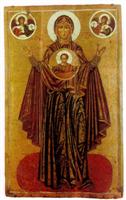
Dr. George K. Papazahos, Assistant Professor of Cardiology at the University of Athens, served as one of Elder Porphyrios' physicians. The following testimony of Dr. Papazahos regarding Elder Porphyrios is included in the book, Elder Porphyrios: Testimonies and Experiences by Klitos Ioannidis (Athens: Holy Convent of the Transfiguration of the Savior, 2007), translated from the Greek 5th edition. The testimony previously appeared in Synaxis (January-March, 1992, pp. 93-97):
"Here I will mention a self-diagnosis of himself. He verified changes in his electrocardiograph without a cardiograph machine. One night, he called me up quite concerned, 'Come here, late as it is, to see the changes in the cardiograph. I was in pain many times today, and the pain was anginal.' Indeed, I ascertained that there were ischaemic changes (to arteries V3-V6) and I asked him under what kind of stress he was today. He began to cry and with frequent interruptions he began describing something in detail to me. He was seeing scenes from the street fighting in Romania. It is was the day when the people rose up against Ceaucescu. With his gift he saw the shootings and the deaths in the squares just like they were being published in the newspapers the following day. He continued to cry, and I begged him to ask God to take away this vision. His heart was in a dangerous state because of the stress. His blockage could get severe.
I found myself in the same kind of stress while witnessing the sensitivity of the 'other' heart of a saint. I avoided looking at the cardiograph and thought to myself, 'What meaning does this nitrite anti-angina medicine that I am about to give you have for you, Elder? You're not of this world. Your heart is beating in Oropos and is living in Romania. On the ECG the heart is shown with an ischaemic "condition" at the ST interval, but in reality can be found "resurrected" to the heavens.' I left there quite late, trembling because I had seen a little of the light of a saint." (268)
Elder Porphyrios "never refused the medical help of the many doctors who were also his spiritual children. In fact, one day I asked him, 'Why do many spiritual people, especially monks, refuse medical help, thinking that the Panagia will help them quickly?' He answered. 'It's egotism. It's the work of the Evil One, thinking that God will make an exception amongst all the others and will miraculously intervene for you. God performs miracles, but you should not expect one for yourself. It's selfishness. On the other hand, God Himself acts through the doctors. 'The Lord gave us physicians and medicine,' says the Holy Scripture.'" (267)
"The Elder, as a doctor, did not only 'see' my physical ailments, he concerned himself with my many spiritual imperfections, too. He tried to help me find humbleness. One afternoon he telephoned me at my office immediately after a couple of patients had expressed their extreme love for me for the care I gave them. I recounted his words, 'George, It's the Elder. Both of us are going to hell together. We'll hear, "You fool, this very night your soul is being demanded from you." You enjoyed the good things in life. "And the things you have prepared whose will they be?"' I interrupted him, 'What did we enjoy in this life, Elder? The broken down car, the empty bank account or the non-existent sleep?' He answered abruptly, 'What's that you're saying? Don't people tell you what a good doctor you are? You love us. You take care of us. You don't skin us alive. And you welcome this praise, you swallow it down. Eh, you've already lost your reward. The same thing happens to me. They tell me that I have "gifts", how I can touch them and perform miracles, that I'm holy. And I gulp it all down, weak fool that I am. Eh, that's why I told you that both of us are going to hell.'
'If we're going to go together,' I replied, 'let's go to hell too!' And he hung up the phone saying, 'I'm speaking to you seriously and you're always joking. Good repentance to the both of us.'
One day I was downcast, thinking that most of my life has gone by pointlessly in the midst of useless daily details. The Elder telephoned me and lifted my spirits with two or three of his expressions, 'Doctor, did you ever hear the phrase, "they will not taste death?" We can, if we wish avoid death. All we have to do is love Christ. You, "with all your heart", Mr. Cardiologist.' He laughed." (270-271)
The healing of soul and body through the ancient Orthodox Christian Way of Life. Copyright © 2009-2013 by Fr. Symeon Sean Kees
Showing posts with label physician. Show all posts
Sunday, February 19, 2012
Tuesday, January 17, 2012
Words for Physicians from the Evergetinos
St. Diadochos:
"There is nothing to prevent us from calling doctors when we fall ill. Since the science of medicine was destined to be discovered at some time through human experimentation, natural remedies were already in existence for this purpose. However, we should not place our hope of healing in doctors but in our true Savior and Physician, Jesus Christ" (115).
St. Barsanouphios:
"If you insist on thinking that this remedy is beneficial for the sick person and it turns out that he is harmed by it, God, Who regards the heart, will not condemn you; for He knows that, although you harmed this person, you wanted to help him. But if someone who is experienced tells you what to do, and you disdain to listen to him and do what you think best, this is arrogance and self-will" (116).
St. Ephraim:
"My beloved, if you have expertise in the science of medicine and are able to cure people, be vigilant, lest in your desire to heal others you show yourself to be full of passions. As the Apostle says: 'Let not your good be evil spoken of' (Romans 14:16)" (117).
The Evergetinos: A Complete Text. Volume 3. Center for Traditionalist Orthodox Studies, 2008.
"There is nothing to prevent us from calling doctors when we fall ill. Since the science of medicine was destined to be discovered at some time through human experimentation, natural remedies were already in existence for this purpose. However, we should not place our hope of healing in doctors but in our true Savior and Physician, Jesus Christ" (115).
St. Barsanouphios:
"If you insist on thinking that this remedy is beneficial for the sick person and it turns out that he is harmed by it, God, Who regards the heart, will not condemn you; for He knows that, although you harmed this person, you wanted to help him. But if someone who is experienced tells you what to do, and you disdain to listen to him and do what you think best, this is arrogance and self-will" (116).
St. Ephraim:
"My beloved, if you have expertise in the science of medicine and are able to cure people, be vigilant, lest in your desire to heal others you show yourself to be full of passions. As the Apostle says: 'Let not your good be evil spoken of' (Romans 14:16)" (117).
The Evergetinos: A Complete Text. Volume 3. Center for Traditionalist Orthodox Studies, 2008.
Saturday, November 19, 2011
St. Athanasius on Christ the Physician
"What man that ever was, for instance, formed a body for himself from a virgin only? Or what man ever healed so many diseases as the common Lord of all? Who restored that which was lacking in man's nature or made one blind from birth to see? Aesculapius was deified by the Greeks because he practiced the art of healing and discovered herbs as remedies for bodily diseases, not, of course, forming them himself out of the earth, but finding them out by the study of nature. But what is that in comparison to what the Saviour did when, instead of just healing a wound, He both fashioned essential being and restored to health the thing that He had formed?"
- St. Athanasius the Great, "Refutation of the Gentiles," On the Incarnation (Crestwood, NY: SVS Press), 1998), 87.
Sunday, August 14, 2011
St. Luke the Surgeon on Science and Religion
St. Luke of Simferpol and Crimea served as a bishop, scientist, medical doctor, surgeon, professor of medicine, and author. His Notes on Purulent Surgery, first published in 1934, may be considered his most significant literary contribution to the surgical arts. You can read about the life of St. Luke, called "the Blessed Surgeon," on the Full of Grace and Truth blog. Information is also available on Orthodoxwiki. The book, The Blessed Surgeon (2nd edition), provides a relatively detailed account of his life.
In an article on "Science and Religion," St. Luke commented on the relationship between science and Orthodox spirituality, true religion. The words of the Blessed Surgeon are relevant today for Orthodox Christians who work in scientific, academic, and/or medical environments steeped in secularism, wherein there is much ignorance regarding the limitation of science and the distinction between scientific knowledge of the rational mind and the theological knowledge of the heart.
St. Luke wrote,
"We are certain that apart from the material world there is an infinite and incomparably superior spiritual world. We believe in the existence of spiritual beings that have higher intellect than us humans. We believe wholeheartedly that above this spiritual and material world there is the Great and Almighty God.
In an article on "Science and Religion," St. Luke commented on the relationship between science and Orthodox spirituality, true religion. The words of the Blessed Surgeon are relevant today for Orthodox Christians who work in scientific, academic, and/or medical environments steeped in secularism, wherein there is much ignorance regarding the limitation of science and the distinction between scientific knowledge of the rational mind and the theological knowledge of the heart.
St. Luke wrote,
"We are certain that apart from the material world there is an infinite and incomparably superior spiritual world. We believe in the existence of spiritual beings that have higher intellect than us humans. We believe wholeheartedly that above this spiritual and material world there is the Great and Almighty God.
What we doubt is the right of science to research with its methods the spiritual world. Because the spiritual world cannot be researched with the methods used to research the material world. Such methods are totally inappropriate to research the spiritual world.
How do we know that there is a spiritual world? Who told us that it exists? If we are asked by people who do not believe in the Divine revelation, we shall answer them thus: 'Our heart told us'. For there are two ways for one to know something, the first is that which is spoken by Haeckel, which is used by science to learn of the material world. There is however another way that is unknown to science, and does not wish to know it. It is the knowledge through the heart. Our heart is not only the central organ of the circulation system, it is an organ with which we know the other world and receive the highest knowledge. It is the organ that gives us the capability to communicate with God and the above world. Only in this we disagree with science.
Praising the great successes and achievements of science, we do not doubt at all its great importance and we do not confine the scientific knowledge. We only tell the scientists "You do not have the capability with your methods to research the spiritual world, we however can with our heart.
There are many unexplainable phenomena which concern the spiritual world that are real (as are some type of material phenomena). There are therefore phenomena that science will never be able to explain because it does not use the appropriate methods.
Let science explain how the prophecies appeared on the coming of the Messiah, which were all fulfilled. Could science tell us how the great prophet Isaiah, some 700 years before the birth of Christ, foretold the most important events in His life and for which he was named the evangelist of the Old Testament? To explain the far sighted grace possessed by the saints and to tell us with which physical methods the saints inherited this grace and how they could understand the heart and read the thoughts of a person they had just met for the first time? They would see a person for the first time and they will call him by his name. Without waiting for the visitor to ask, they would answer on what troubled him.
If they can, let them explain it to us. Let them explain with what method the saints foretold the great historical events which were accurately fulfilled as they were prophesied. Let them explain the visitation from the other world and the appearance of the dead to the living.
They shall never explain it to us because they are too far from the basis of religion- from faith. If you read the books of the scientists who try to reconstruct religion, you will see how superficially they look at things. They do not understand the essence of religion yet they criticize it. Their criticism does not touch the essence of faith, since they are unable to understand the types, the expressions of religious feeling. The essence of religion they do not understand. Why not? Because the Lord Jesus Christ says 'No one can come to me unless My Father who sent Me draws him to Me.' (John 6:44)
So it is necessary that we be drawn by the Heavenly Father, it is necessary that the grace of the Holy Spirit enlighten our heart and our mind. To dwell in our heart and mind through this enlightenment, the Holy Spirit and the ones who were found worthy to receive the gift of the Holy Spirit, those in whose heart lives Christ and His Father, know the essence of faith. The others, outside the faith cannot understand anything."
Source of quote here. The image is from Orthodoxwiki. This icon was authored by Father Daniel from the Holy Hesychastirio of Daniel the Katounakian, Mount Athos and is kept at the Holy Church of St. Paraskevi, Koropi, Attica of Greece. Permission is granted to copy, distribute and/or modify this document under the terms of the GNU Free Documentation License, Version 1.2 or any later version published by the Free Software Foundation; with no Invariant Sections, no Front-Cover Texts, and no Back-Cover Texts.
Thursday, July 21, 2011
A Discussion with Dr. H. Tristram Engelhardt, Jr:
Dr. Engelhardt, MD, PhD, is one of the top bioethicists in the world. He is the author of The Foundations of Christian Bioethics and Senior Editor of Christian Bioethics journal (Oxford University Press). In a video of a discussion that took place at St. Luke's Orthodox Cathedral in Hong Kong, Dr. Engelhardt talks about the Orthodox Christian practice of medicine and bioethics. In the video, he mentions "Question 55" of St. Basil the Great's Long Rules, which I previously posted.
This video can also be found on Youtube.
Thursday, July 14, 2011
St. Basil the Great on the Art of Medicine
Selections from St. Basil regarding "Whether recourse to the medical art is in keeping with the practice of piety."
"In as much as our body is susceptible to various hurts, some attacking from without and some from within by reason of the food we eat, and since the body suffers affliction from both excess and eficiency, the medical art has been vouchsafed us by God, who directs our whole life, as a model for the cure of the soul, to guide us in the removal of what is superfluous and in the addition of what is lacking. Just as we would have no need of the farmer's labor and toil if we were living amid the delights of paradise, so also we would not require the medical art for relief if we were immune to disease, as was the case, by God's gift, at the time of Creation before the Fall.. After our banishment to this place, however, and after we had heard the words: 'In the sweat of thy face shalt thou eat thy bread,' through prolonged effort and hard labor in tilling the soil we devised the art of agriculture for the alleviation of the miseries which followed the curse, God vouchsafing us the knowledge and understanding of this art. And, when we were commanded to return to the earth whence we had been taken and were united with the pain ridden flesh doomed to destruction because of sin and, for the same reason, also subject to disease, the medical art was given to us to relieve the sick, in some degree at least."
"Now, the herbs which are the specifics for each malady do not grow out of the earth spontaneously; it is evidently the will of the Creator that they should be brought forth out of the soil to serve our need. Therefore, the obtaining of that natural virtue which is in the roots and flowers, leaves, fruits, and juices, or in such metals or products of the sea as are found especially suitable for bodily health, is to be viewed in the same way as the procuring of food and drink. Whatever requires an undue amount of thought or trouble or involves a large expenditure of effort and causes our whole life to revolve, as it were, around solicitude for the flesh must be avoided by Christians. Consequently, we must take great care to employ this medical art, if it should be necessary, not as making it wholly accountable for our state of health or illness, but as redounding to the glory of God and as a parallel to the care given the soul. In the event that medicine should fail to help, we should not place all hope for the relief of our distress in this art, but we should rest assured that He will not allow us to be tried above that which we are able to bear. Just as in those days the Lord sometimes made clay, and anointed, and bade wash in Siloe, and on other occasions was content with the mere command: ‘I will, be thou made clean’ whereas He left some to struggle against their afflictions, rendering them more worthy of reward by trial, so it also is with us. He sometimes cures us secretly and without visible means when He judges this mode of treatment beneficial to our souls; and again He wills that we use material remedies for our ills, either to instil in us by the prolonged nature of the cure an abiding remembrance of the favor received, or, as I have said, to provide an example for the proper care of the soul. As in the case of the flesh it is essential to eliminate foreign elements and add whatever is wanting, so also, where the soul is concerned, it behooves us to rid ourselves of that which is alien to it and take unto ourselves that which is in accordance with its nature; for 'God made man right and He created us for good works that we might walk in them."
"To place the hope of one's health in the hands of the doctor is the act of an irrational animal. This, nevertheless, is what we observe in the case of certain unhappy persons who do not hesitate to call their doctors their saviors. Yet, to reject entirely the benefits to be derived from this art is the sign of a pettish nature."
"When the favor of a cure is granted us, whether by means of wine mixed with oil, as in the case of the man who fell among the robbers, or through figs, as with Ezechias, we are to receive it with thanksgiving. Besides, we shall view the watchful care of God impartially, whether it comes to us from some invisible source or by a physical agency, the latter, indeed, frequently engendering in us a livelier perception of the favor as coming from the hands of God. Very often, also, the diseases which we contracted were for our correction and the painful remedies we were obliged to submit to formed part of the instruction. Right reason dictates, therefore, that we demur neither at cutting nor at burning, nor at the pains caused by bitter and disagreeable medicines, nor at abstinence from food, nor at a strict regimen, nor at being forced to refrain from that which is hurtful. Nevertheless, we should keep as our objective (again I say it), our spiritual benefit, in as much as the care of the soul is being taught in the guise of an analogy. There is no small danger, however, that we will fall into the error of thinking that every kind of suffering requires medical relief. Not all sicknesses for whose treatment we observe medicine to be occasionally beneficial arise from natural causes, whether from faulty diet or from any other physical origin."
"So, then, we should neither repudiate this art altogether nor does it behoove us to repose all our confidence in it; but, just as in practicing the art of agriculture we pray God for the fruits, and as we entrust the helm to the pilot in the art of navigation, but implore God that we may end our voyage unharmed by the perils of the sea, so also, when reason allows, we call in the doctor, but we do not leave off hoping in God. It seems to me, moreover, that the medical art is no small aid to continency."
St. Basil the Great, “Question 55” in “The Long Rules,” St. Basil: Ascetical Works, trans. by M. Monica Wagner, The Fathers of the Church: A New Translation, Vol. 9 (Wash., D.C.: Catholic University of America Press, 1962), 330-337. The text of this book is available online in various formats: http://www.archive.org/details/fathersofthechur027835mbp.
Monday, July 11, 2011
"Christian Bioethics in a Post-Christian World"
In April 2011, Dr. H. Tristram Engelhardt, Jr. (Prof. Emeritus, Baylor College of Medicine/ Prof., Rice University), one of the top bioethicists in the world, spoke at a bioethics conference in Houston, TX. The conference focused on Health Care in a Secular Culture: The Conscience of Physicians & Nurses at Risk. Dr. Engelhardt presented a paper on Orthodox Christian bioethics entitled, "Christian Bioethics in a Post-Christian World: Facing the Challenges." I highly recommend this lecture for those who labor in the healthcare field, students preparing for such work, and others interested in the difference between "traditional Christianity" (i.e., the Orthodox Christian Way of Life) and secularism.
The video is also available on Youtube.
Friday, June 24, 2011
"Doctor as Renegade" (MN Public Radio)
A great article and video about medical care is available on the Minnesota Public Radio website. Dr. Susan Rutten Wasson, a physician in private practice, doesn't accept medical insurance. She does accept cash payment and non-monetary reimbursement from her patients.
In order for Orthodox Christian physicians to provide the best medical care possible according to Orthodox Tradition, they must not allow insurance companies, government reimbursement programs, or secular administrative structures negatively affect the quality of care they offer their patients. The option of accepting cash reimbursement, but not insurance, is worth considering when constructing a plan to launch an Orthodox Christian medical facility, whether a group or private practice.
Family life and patient care may be simpler and better off the insurance grid.
In order for Orthodox Christian physicians to provide the best medical care possible according to Orthodox Tradition, they must not allow insurance companies, government reimbursement programs, or secular administrative structures negatively affect the quality of care they offer their patients. The option of accepting cash reimbursement, but not insurance, is worth considering when constructing a plan to launch an Orthodox Christian medical facility, whether a group or private practice.
Family life and patient care may be simpler and better off the insurance grid.
Monday, February 28, 2011
More on the Physicians of the Church
Visit the Full of Grace and Truth blog for a post including information on many of the Physicians of the Church. The post provides an impressive list of Saints who practiced the healing arts according to the Orthodox Christian Faith and in the context of the ancient Church. You can also look under the Holy Unmercenaries label on the same site for valuable information. The Saints serve as role models for those in the medical field who desire to care for their patients with love and prayer and contribute to the healing of the whole person, body and soul.
Saturday, March 13, 2010
Theology and the Limitations of Psychology
Orthodox theology is revealed knowledge acquired through the experience of God. Theology shows us what a whole, healed, perfect human person looks like. This is the image given to Sts. Peter, James, and John on Mount Tabor. (1) The Orthodox Way shows us who human beings were intended to be in the beginning, who we are now, and who we can become. By way of experiential revealed theology, not speculative rational philosophy or theorizing, we know the ultimate cause of our problems and the most thorough cure for the healing of the human person.
Secular psychology is quite limited. It is based, not on revelation, but on the observation of fallen humanity (that is, human beings who are afflicted by death and its symptom - the sickness of soul and body). A “normal” person through the perspective of psychology is still a person suffering from sickness, corruption, and death. "Normal" in a secular sense is far from perfection.
While the Orthodox understand human behavior and the cure of the human person from within the revealed Tradition, which has been passed down and lived through the centuries from generation to generation, secular psychology is constantly observing human behavior and rationally speculating on causes for behaviors and methods for treatment. While the methods of secular psychology can help people to some degree on a psychological (rational) and emotional level, it can never reach far enough to heal the soul on the spiritual level, where the root cause of sickness lies. The Orthodox Way, on the other hand, penetrates deeply into the soul to cure the entire human person.
Theories of secular psychology cannot be effectively grafted onto the inexhaustible Mystery of the Orthodox Church. The social sciences, including psychology, like the hard sciences, are by nature always open to change. No scientific theory based on human ideas about the created universe should be dogmatized, but all theories, models, and views may be challenged, changed, or discarded in light of new evidence. Revealed divine theology, which remains constant and abides in fullness within the Church, can never be tied to or integrated with humanly-made scientific theories or philosophies that progress and change over time. Secular psychology has nothing to teach the Church, which is the “pillar and ground of truth” and fountain of healing. Orthodox mental health professionals may, however, find helpful techniques developed within secular psychology based on observation of human behavior that could prove useful when firmly planted in the phronema (mind) and life of the Orthodox Church, the healing context of the Orthodox Way.
A lay Orthodox mental health professional, dedicated to prayer, can make known the active presence and unconditional love of God to those who seek healing. Some patients will be open to pursuing the deepest healing within the life of the Church, while others may deny the spiritual reality or resist addressing spiritual issues. Even in secular facilities, Orthodox therapists may be permitted to ask clients about their religious/spiritual backgrounds and may endeavor to help the person understand who the true God is while guiding them toward an understanding of God's love for us. In our society, people (including atheists) tend to have a concept of God based to Western ideologies. A mental health professional can perhaps share parables about the kingdom of heaven from the Holy Gospels and passages from the writings of the Fathers. Hopefully, many Orthodox mental health care centers will be established wherein patients, Orthodox Christians and non-Orthodox people, can receive quality care according to the Orthodox ethos within the context of the life of the Church.
Orthodox mental health professionals who wish to be the offer the best care must pursue their own salvation with humility, prayer, and repentance.
(1) See a sermon by St. Gregory Palamas on the Transfiguration on the OCA website.
Wednesday, January 13, 2010
"Care at the End of Life"
by His Grace Bishop THOMAS
Orthodox Christianity offers orientation in the cosmos. More precisely, it leads us away from our passions and purifies our hearts so that we can be illumined by the uncreated energies of God and come into union with Him. (1) Contemporary man finds himself bereft of such orientation. Both his life and his death tend to be trivialized, reduced to what can make sense without any recognition, much less experience, of transcendent meaning, purpose, and obligation. As a consequence, much reflection on end-of-life decision-making gives priority, if not exclusive attention, to comfort care, death with dignity, and the preservation of personal autonomy until death. All of this is done without ever asking the foundational question, What was life really all about? much less the foundational spiritual question of how I should and can repent from a life that was poorly lived so as finally to turn in repentance to God. Properly directed care at the end of life is care that focuses on repentance. To talk about end-of-life decision-making and not to place centrally the urgent issue of repentance is to miss the target completely. Care at the end of life should offer a final opportunity to the dying person to find orientation. That is, end-of-life care must bring the dying person to repentance through a recognition of how the holy, indeed, God, defines the meaning of the right, the good, and the virtuous. Good end-of-life care cannot be the product of a secular or philosophical bioethics. It must be the proclamation of a living theology. Orthodox Christianity teaches how to become oriented in life and to achieve a good death. What is important to be said cannot be stated adequately in secular terms.
II. Against the Grain of Secular Culture: Remembering That One’s Religion Is Not a Personal Matter
We live in a world that increasingly accepts passive euthanasia in the sense of withdrawing or withholding treatment with the intention to bring about an earlier death. More and more, this world accepts not only active euthanasia (for example, the use of analgesics to hasten death), but also physician-assisted suicide and blatant voluntary active euthanasia. All of this is exactly what a bad death is about: it is focused on the willful control of the end of one’s own life, rather than on humility and repentance. Orthodox Christianity brings a quite different message. Orthodox Christianity teaches repentance, conversion, and the importance of turning to God. It surely does have concerns with the good, with justice, and with protecting life. But these concerns are set within concerns for the holy. Orthodox Christianity is not against making the world better; indeed, it knows that in the end the world will be made better after Christ comes in judgment (Revelation 21). In the meantime, the Orthodox Church must remind the world that the first Orthodox Christian convert to enter heaven was the thief on the cross, who did no good thing save to repent and convert (Luke 23:39–43). The thief had no opportunity after his conversion to accomplish anything worthwhile. Literally at the end, however, he turned to holiness, which holiness is personal: the triune God. Orthodox Christians, too, realize that truth is not propositional, but personal. Because of his conversion, the thief on the cross had a good death. Orthodox Christianity has to teach first and foremost that we should turn to that Truth and, in so turning, we will come to know holiness. This fact of the matter, that truth exists and is personal, should orient our lives and our deaths, and should direct all end-of-life decision-making. It should help us to see the death of the thief as the icon of a good death.
The personal character of the truth is one of the central distinguishing marks of Orthodox Christian theology. To begin with, those who are theologians in the strict sense are not those who merely know about God, but those who know God: they are holy Fathers. At least half of the great Orthodox theologians of the twentieth century were not academicians; many never attended a university. Yet they had noetically experienced God. They had come to know God. (2) This is why the Orthodox Church rarely, and only for rhetorical purposes, gives proofs for the existence of God. Otherwise, such endeavors would be something like a wife developing five proofs for the existence of her husband with whom she lives. Offering such proofs would be a hint that she is alienated from her husband, that she no longer experiences his presence. Because we experience God, we do not believe in his existence as one might believe in a philosophical proposition. His presence is realized in our lives and in our deaths. For this reason, instruction in how to die well is not derived from manuals and treatises, but from accounts of the lives and the deaths of saints. We look to the models of proven successful dying. This point of attention always directs us beyond the good towards the holy.
Because it is central to understand the good, the right, and the virtuous only with reference to God, Orthodox Christianity refuses to accept the dilemma that Plato (428–348 B.C.) develops in his dialogue, Euthyphro. In response to the question as to whether the good is good because God approves of it, or whether God approves of it because it is good, Orthodox Christianity realizes that the good, including the good of a good death, can never be understood adequately apart from God. It is something like not being able to understand the orbits of the planets without reference to the sun. Orthodox Christianity refuses to reduce theology or moral issues to natural-law reflections or discursive philosophical analyses and arguments. It focuses instead on the kind of person we should be for eternity. It does this in the face of a Truth that it is absolute and enduring: the Persons of the Trinity.
In contrast, spiritual character-building in our contemporary culture is frequently regarded as a do-it-yourself task, like the assembly of a meal in a cafeteria. The result is that one examines various moral and religious positions as if they were dishes from which one could sample and choose on one’s own, composing in an aesthetic and willful fashion one’s own life and one’s own death. Orthodox Christianity, in contrast, reminds persons that they must rightly orient their life-anddeath choices through ascetically directing their lives to the meaning of the universe, Who is God. Orthodox Christianity is thus not simply pro-life, but pro-life directed to God, which direction in our lives and deaths is only achieved through ascetic struggle. One can only have a rightly-ordered ethic of life through turning rightly to God. The good cannot be understood apart from the holy. A philosophical analysis and refl ection will never be enough. (3) Orthodox Christianity, as a consequence, does not offer an ethic of life, but a way of rightly and theologically living one’s life. There can be no adequate understanding of rightly directed decision-making at the end of life, absent an adequate theological orientation.
Although life in general, and dying in particular, are ascetic struggles, one should note that Orthodox Christianity recognizes the importance of pain control and comfort care. In particular, Orthodox Christianity has from the beginning appreciated that pain and distress can bring the dying to temptation and despair, thus leading them away from a wholehearted pursuit of salvation. St. Basil the Great (329–379) therefore notes with approval that “with mandrake doctors give us sleep; with opium they lull violent pain.” (4) Indeed, twice in each Liturgy, the Church prays for “a Christian ending to our life, painless, blameless, peaceful, and a good defense before the fearful judgment seat of Christ.” (5) This prayer emphasizes the goodness of a death that is painless and peaceful. In so doing, however, it does not lose sight of the great offering to God made by the death of martyrs. In all these cases, a blameless death is like the death of the thief, repentant and marked by confession of Christ. As a result, there is nothing more frightening than the prospect of dying peacefully in one’s sleep without warning, without a final opportunity for prayer and repentance. In summary, with regard to decision-making at the end of life, there must be a focus on God, and this can require withholding and withdrawing treatment when such would distract from turning wholeheartedly to God. The focus remains on wholeheartedly aiming at repentance.
III. Seeing the Big Picture
Life lived fully within the horizon of the finite and the immanent has a trivial character in contrast to a life lived in recognition of God. So, too, does end-of-life decision-making remain radically misdirected and incomplete, no matter how much it might be embedded within a concern for death with dignity or directed by an ethic of life. Set within the horizon of the finite and the immanent, reflections on one’s death and decision-making at the end of life highlight creature comforts for a creature who thinks of himself as about to go out of existence. One is blind to the earnestness of taking advantage of final opportunities rightly to orient one’s life towards the future beyond death, that is, to God. Orthodox Christianity has the task of pointing out this big picture: the significance of death and the nature of the truth. As to the latter, Orthodoxy reminds the world of Who this Truth is. Only oriented to the Triune God can one in the end understand the meaning of life, the signifi cance of death, and the goal to which one should direct one’s decisions at the end of life.
ENDNOTES
1 The final stage beyond illumination (theoria or union with God) is what is achieved by true theologians. “The mystical and perfecting stage is that of the perfected ones, who in fact become the theologians of the Church” (Hierotheos, Bishop of Nafpaktos, Orthodox Spirituality, trans. Effie Mavromichali, [Levadia, Greece: Birth of the Theotokos Monastery, 1994], p. 50).
2 “The theologians of the Church are only those people who have arrived at a state of theoria, which consists in illumination and theosis. Illumination is an unceasing state, active day and night, even during sleep. Theosis is the state in which someone beholds the glory of God, and it lasts as long as God sees fit” (John S. Romanides, Patristic Theology, trans. Hieromonk Alexis [Trader], [Goldendale, Washington: Uncut Mountain Press, 2008], p. 50).
3 Orthodox Christianity has an attitude towards philosophical reflection like that of St. Paul’s: “Where is the wise? Where is the scribe? Where is the disputer of this age? Did not God make foolish the wisdom of this world? For since, in the wisdom of God, the world knew not God through its wisdom, it pleased God through the foolishness of the preaching to save those who believe. For indeed, Jews ask for a sign, and Greeks seek wisdom, but we proclaim Christ Who hath been crucified; to the Jews, on the one hand, a stumbling block, and to Greeks, on the other hand, foolishness” (1 Cor 1:20–23). This Pauline insight is often reinforced by the Fathers. One might consider the rather critical things St. John Chrysostom has to say regarding secular Greek philosophy. See, for example, his first Homily on the Gospel of Saint Matthew and his second Homily on the Gospel of Saint John.
4 St. Basil the Great, “The Hexaemeron,” Homily 5, §4, in Nicene and Post-Nicene Fathers, Second Series, eds. Philip Schaff and Henry Wace (Peabody, Massachusetts: Hendrickson Publishers, 1994), vol. 8, p. 78.
5 The Liturgikon (Englewood, New Jersey: Antakya Press, 1989), pp. 281, 299.
(The article is by His Grace Bishop THOMAS, Diocese of Charleston, Oakland, and the Mid-Atlantic, Antiochian Orthodox Christian Archdiocese of North America. Used by permission.)
Thursday, December 31, 2009
Physicians Preserving Life in the Womb

When an Orthodox Christian physician provides medical care to a pregnant woman, the physician finds two patients under his care, mother and child. By the efforts of the physician, may the health of both be improved and preserved.
A physician may encounter a woman who does not want her child or even recognize the fetus as a child. An Orthodox Christian physician must be careful not only to refuse to assist in an abortion, but must also be careful not to merely redirect the mother to another provider who will perform an abortion. If a stranger approaches an Orthodox Christian man and asks, "Will you kill a family member for me?," the Christian should not respond, "Of course, not! - but, I know a hitman who will. He'll do it quickly, effectively, and with as little danger to your other family members as possible." The Orthodox Christian should clearly refuse to commit murder and to aid a potential murderer in carrying out the evil scheme. The time when a scared and confused mother in a chaotic life-situation seeks an abortion may not be a good moment for the physician to abandon a patient by leaving her to an abortionist, although the patient can make a decision to abandon the physician and seek a secular abortionist to carry out her plans. Rather, an Orthodox Christian physician who encounters a woman desiring an abortion can aid a woman's rise out of her own delusion and egotism to realize that she has child (her own child) within her womb and that she is truly a mother, who is called to be a mother after the image of the Theotokos and all the nurturing mother-Saints who have brought forth children.
When caring for young women with unexpected and/or unwanted pregnancies, all who care should do so with great tenderness and love. Information regarding adoption and caring for the child in the context of the family and church can be discussed. Certainly, the physician can call upon a priest to speak with the mother if she is willing. Ultimately, a woman will exercise her will to choose what she will do. The physician, however, should clearly indicate that he is obliged to care for both patients, that abortion is simply the murder of an innocent child (even if the child's conception involved an act of violence), and that, while he will take no part in the murder of a child, he will help the woman in the process of bringing the child into life in the world.
While abortion is often seen as a political issue in our society, for Orthodox Christians it is a matter of expressing love to give life or murdering an innocent victim because of self-love (narcissism/egotism) and delusion. With love and prayer, the physician may be able to preserve the life of a baby and point the mother toward a healthier, spiritually nourishing life.
Selections from early Christian writings, a description of the development of a child in the womb, and other relevant resources can also be found on the Antiochian Archdiocese website.The Orthodox Christian approach to abortion is expressed in a brief submitted to the US Supreme Court (pdf).
The Office of Prayer and Supplication for the Victims of Abortion (pdf) is available on the Antiochian Archdiocese website.
Monday, December 28, 2009
Unmercenary Physicians Cyrus and John
You can listen to an account of the lives of Sts. Cyrus and John the Unmercenary Physicians (martyred c. AD 304) on an Ancient Faith Radio podcast.Also, read about the lives of Sts. Cyrus and John on the OCA website.
They are commemorated every year on January 31st.
Tuesday, December 22, 2009
Great Martyr Anastasia, Deliverer from Potions
St. Anastasia "went from city to city ministering to Christian prisoners. Proficient in the medical arts of the time, she zealously cared for captives far and wide, healing their wounds and relieving their suffering. Because of her labors, St. Anastasia received the name Deliverer from Potions (Pharmakolytria), since by her intercessions she healed many from the effects of potions, poisons, and other harmful substances." (Antiochian Orthodox Archdiocese/OCA)The Orthodox Church commemorates the Great Martyr Anastasia on December 22nd.
Read more about the life of St. Anastasia on the Orthodox Church in America (OCA) website or listen to an account of her life on Ancient Faith Radio.
Thursday, December 17, 2009
Holy Unmercenary Physicians Cosmas and Damian
Among the Unmercenary Physicians of the Orthodox Church are three sets of brothers named Cosmas and Damian: Sts. Cosmas and Damian of Cilicia (Arabia) (Oct. 17), Sts. Cosmas and Damian of Asia Minor or Mesopotamia (Nov. 1), and Sts. Cosmas and Damian of Rome (July 1). These links go to accounts of their lives on the website of the Orthodox Church in America (OCA).You can also listen to accounts of the lives of Sts. Cosmas and Damian of Cilicia and Sts. Cosmas and Damian of Rome on an Ancient Faith Radio podcast.
St. Theodeta, whose life is briefly mentioned on the Antiochian Orthodox Archdiocese website, is the mother of the twin Sts. Cosmas and Damian of Asia Minor.
Icon: IconoGraphics ColorWorks Collection, TheoLogic Systems, Theologic.com
Wednesday, December 16, 2009
Orthodox Christian Medical Care in the Eastern Roman Empire
“From their origins in the fourth century until 1453 Byzantine hospitals were conceived as expressions of Christian charity. They carried out in the real world the orthodox doctrine regarding philanthropic medicine. When Basil the Great opened his extensive charitable institution—his ptochotropheion—outside Caesarea, he saw its medical services as the deepest possible expressions of philanthropia. As Greagory of Nazianz phrased it, one could see there love put to the test in their treatment of disease. John Chrysostom built his hospitals in Constantinople 'for the glory of Christ' and staffed them with ascetics who viewed their service to the sick as a religious duty. Sampson, the legendary physician of the Eastern capital, founded his hospital on the principles of the physicians’ profession and on the divine laws which Christ laid down. Even after Justinian introduced the archiatroi of the ancient pagan profession in the Christian xenones, a step which encouraged lay professionals to enter hospital service at all levels on the staff, the religious mission of the nosokomeion was never forgotten. When, about 800, Theodore Stoudites described a large nosokomeion with a complete staff of physicians and nurses, he emphasized that all the doctors from the chief physicians to the practical nurses strove to follow the divine plan of philanthropia. When John II Komnenos established the Pantokrator Xenon in the twelfth century, he prayed that it would always be a fountain of mercy, a refuge for men and women, a pure offering to the Lord. Moreover, John hoped that the philanthropia which he displayed in founding this hospital would attain for him the forgiveness of his many sins. The emperor also reminded the physicians, medical assistants (hypourgoi), and servants of the Pantokrator that they should never neglect patients, since Christ, the Creator of All, considered these sick his beloved brethren. Thus, John wanted the monks and the lay staff of the Pantokrator complex to care not only for the buildings he had built—the lifeless temples—but especially for the patients of the hospital—the living temples of God.” Note: Philanthopia – “love toward mankind”
Source: Timothy S. Miller, The Birth of the Hospital in the Byzantine Empire (Baltimore: Johns Hopkins University Press, 1985), 61-62.
(The image is a copy of the Hippocratic Oath from the Byzantine Empire.)
Orthodox Christian Health Care Providers in a Secular Environment
“Traditional Christians will be morally disruptive. Contrary to the liberal cosmopolitan ethic, they will indeed seek opportunities for converting others and directing them away from sin, as did the holy unmercenaries of the first centuries. The liberal cosmopolitan is right in discerning a real conflict between the duties of physicians as citizens of a social democracy and physicians as committed traditional Christians. The religious moral integrity of the traditional Christian will be expressed both in stepping back from any involvement in forbidden activities (e.g., abortion, artificial insemination from a donor, physician-assisted suicide) and in providing a witness to the truth of Christianity, which is always an invitation to repentance and conversion” (379).Source: H. Tristram Engelhardt. The Foundations of Christian Bioethics. Lisse, The Netherlands : Swets & Zeitlinger Publishers, 2000. (Dr. Engelhardt is a Reader in the Orthodox Christian Church.)
Great Martyr Panteleimon, the Unmercenary Physician
The Great Martyr Panteleimon (martyred c. AD 305) is one of the great Unmercenary Physicians of the Orthodox Church. Listen to an account of the life of St. Panteleimon on Ancient Faith Radio or read an account of his life on the Greek Orthodox Archdiocese website.An Akathist to Great Martyr-Healer Panteleimon, a service through which we ask for the intercessions of St. Panteleimon on behalf of the sick for the healing of their souls and bodies, is available online. The text has been made available as a PDF file by St. Barbara Antiochian Orthodox Church in Costa Mesa, CA.
Here is a selection from the Akathist:
Possessed by a storm of polytheistic thoughts, the impious Emperor was confused on learning from the doctors who
were jealous of thee that thou healest all kinds of incurable illnesses by the name of Christ. And we, glorifying with gladness our wonderful God in thee, cry to Him: Alleluia! (Kontakion 4)
Most Holy Saint and Martyr Panteleimon-the-Healer, intercede to the Most Merciful God for [Name(s)] for the healing of his (or her, their) soul(s) and body (bodies).
When the people of Nicomedia heard of thy great compassion for the suffering and of thy free healing of all illnesses, all rushed to thee with faith in the healing Grace in thee, and receiving swift healing of all their diseases they glorified God and magnified thee, their most gracious healer, crying to thee:
Rejoice, thou who art anointed with the myrrh of Grace!
Rejoice, sanctified temple of God!
Rejoice, great glory of the pious!
Rejoice, firm wall of the oppressed!
Rejoice, thou who surpassest the wise in knowledge!
Rejoice, thou who enlightenest the thoughts of the faithful!
Rejoice, recipient of divine gifts
and source of many of the Lord’s mercies to us!
Rejoice, speedy helper of the suffering!
Rejoice, harbor of the storm-tossed!
Rejoice, instructor for those astray!
Rejoice, thou who dost heal the sick freely!
Rejoice, thou who dost impart healing abundantly!
Rejoice, Great Martyr and Healer Panteleimon! (Ekos 4)
Sunday, December 13, 2009
"Honor the Physician" - A Selection from Holy Scripture
"Honor the physician with the honor due him, and also according to your need of him, for the Lord created him. Healing comes from the Most High, and he will receive a gift from the king. The physician's skill will lift up his head, and he shall be admired in the presence of the great.
The Lord created medicines from the earth, and a sensible man will not loathe them. Is not water made sweet by wood that its strength might be known? And He gave skill to men that He might be glorified in His wonders. By them He heals and takes away pain, a druggist making a compound of them. God's works are never finished. And from Him health is upon the face of the earth.
My son, do not be negligent when you are sick. But pray to the Lord and He will heal you. Depart from transgression and direct your hands aright, and cleanse your heart from every sin. Offer a sweet-smelling sacrifice and a memorial of the finest wheat flour; and pour oil on your offering, as if you are soon to die. And keep in touch with your physician, for the Lord created him, and do not let him leave you, for you need him. There is a time when success is also in their hands, for they will pray to the Lord to give them success in bringing relief and healing, for the sake of preserving your life. He who sins before the One who made him, may he fall into the hands of a physician."
- The Holy Scripture, Wisdom of Sirach 38:1-15 (LXX, SAAS translation).
Subscribe to:
Comments (Atom)