The video is also accessible at TED.com.
Showing posts with label prenatal care. Show all posts
Showing posts with label prenatal care. Show all posts
Friday, February 17, 2012
"Conception to Birth - Visualized" (TED.com)
Here is a beautiful TED presentation entitled, Conception to Birth - Visualized," by Alexander Tsiaras.

Thursday, February 16, 2012
Record of Protest Against the Infringement of Religious Liberty by the Department of Health and Human Services

In this ruling by HHS, religious hospitals, educational institutions, and other organizations will be required to pay for the full cost of contraceptives (including some abortion-inducing drugs) and sterilizations for their employees, regardless of the religious convictions of the employers.
The First Amendment of the U.S. Constitution guarantees the free exercise of religion. This freedom is transgressed when a religious institution is required to pay for 'contraceptive services' including abortion-inducing drugs and sterilization services that directly violate their religious convictions. Providing such services should not be regarded as mandated medical care. We, the Assembly of Canonical Orthodox Bishops, call upon HHS Secretary Sebelius and the Obama Administration to rescind this unjust ruling and to respect the religious freedom guaranteed all Americans by the First Amendment."
The original statement can be viewed on the website of the Assembly of Canonical Orthodox Bishops of North and Central America.
The photo of the Assembly of Bishops is copyrighted (DIMITRIOS@PANAGOS.COM) and is used here according to Fair Use. The image is from Orthodoxwiki.org.
Monday, February 13, 2012
The 180 Movie: Abortion, Young Americans & Compartmentalism
To live the Orthodox Christian Way involves possessing the Orthodox mind, ethos, and worldview, which remains unchanged in all places and in all ages. This Orthodox way of thinking and seeing permeates all aspects of our lives: personally, privately, within the family, in the workplaces, and publicly. Unfortunately, our neighbors who live and work alongside of us in our secular Western culture often suffer from compartmentalism. That is, they knowingly or unknowingly separate their lives into philosophical compartments bearing labels such as political philosophy, private relationship philosophy, work relationship philosophy, religious philosophy, spiritual philosophy, work philosophy, historical philosophy, social justice philosophy, etc. When one suffers from compartmentalism, the person may say one believes something with regard to religious teaching, but the stated belief isn't actually expressed in his or her relationships with the opposite sex or evident in conversation regarding politics.
As Orthodox Christians, we are called to live the Way of Christ that we might be of one mind, one heart, one ethos, one worldview. This is only possible by immersing ourselves in the life of the Church, the path of humility, repentance, love, and prayer. The Orthodox Way is not the way of rational philosophy but of the noetic knowledge of the heart.
The movie 180 demonstrates the lack of a holistic way of thinking and seeing among young Americans, specifically with regard to views on abortion. Even when members of the younger generation know intellectually that the baby in the womb is alive, they have been indoctrinated to accept the idea that abortion should remain legal because of a woman's "right to choose" to "terminate the pregnancy," especially in certain circumstances. So, a severe contradiction exists between what some say they believe with regard to the life of the child in the womb and what they believe according to a political philosophy rooted in secularism. If abortion is seen primarily as a political issue (pro-life v. pro-choice) emphasizing the personal autonomy of the woman to make choices regarding her body, then attempts to stop legal abortion may be viewed as "politicizing health care" rather than attempts to end the legalized murder of innocent babies.
Not only does the Orthodox Church reject compartmentalism, but also rejects the confusion between rational philosophy (models based on concepts) and theology (knowledge of God by experience of the heart, not concepts in the rational mind). The pursuit of theology within the life of the Church, which is only pursued through prayer and repentence, not by academic study or scientific inquiry, brings one to a Way of living wherein all things, by the Spirit, are seen through a single lens and understood outside of philosophical contradictions between spirituality, religion, vocation, relationships, politics, etc.
180 is a fascinating piece of work that demonstrates ignorance (lack of education) regarding history and the problems of compartmentalism in a secular pagan society.
More information on the historic approach to abortion in the ancient Church is available under the prenatal care section of this blog.
Friday, January 29, 2010
Kh. Frederica on the Sanctity of Life
 Listen to Kh. Frederica Mathewes-Green's presentation for the Pan-Orthodox Sanctity of Life Sunday on Ancient Faith Radio.
You can also read Kh. Frederica's articles, "Three Bad Ideas for Women," "Post-Abortion Men, Natural Consequences," "Abortion Politics and the 'Rape and Incest' Exception," and others on her website (frederica.com).
Saturday, January 2, 2010
Mental Illness & Demonic Possession / Life Before Birth
The article, "Orthodoxy and the Unborn Child," by Christopher Humphrey, Ph.D, can be found in the same issue.
This entire issue is available as a pdf file on the Antiochian Orthodox Christian Archdiocese website.
Thursday, December 31, 2009
Physicians Preserving Life in the Womb
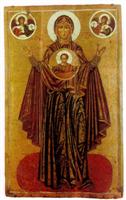
When an Orthodox Christian physician provides medical care to a pregnant woman, the physician finds two patients under his care, mother and child. By the efforts of the physician, may the health of both be improved and preserved.
A physician may encounter a woman who does not want her child or even recognize the fetus as a child. An Orthodox Christian physician must be careful not only to refuse to assist in an abortion, but must also be careful not to merely redirect the mother to another provider who will perform an abortion. If a stranger approaches an Orthodox Christian man and asks, "Will you kill a family member for me?," the Christian should not respond, "Of course, not! - but, I know a hitman who will. He'll do it quickly, effectively, and with as little danger to your other family members as possible." The Orthodox Christian should clearly refuse to commit murder and to aid a potential murderer in carrying out the evil scheme. The time when a scared and confused mother in a chaotic life-situation seeks an abortion may not be a good moment for the physician to abandon a patient by leaving her to an abortionist, although the patient can make a decision to abandon the physician and seek a secular abortionist to carry out her plans. Rather, an Orthodox Christian physician who encounters a woman desiring an abortion can aid a woman's rise out of her own delusion and egotism to realize that she has child (her own child) within her womb and that she is truly a mother, who is called to be a mother after the image of the Theotokos and all the nurturing mother-Saints who have brought forth children.
When caring for young women with unexpected and/or unwanted pregnancies, all who care should do so with great tenderness and love. Information regarding adoption and caring for the child in the context of the family and church can be discussed. Certainly, the physician can call upon a priest to speak with the mother if she is willing. Ultimately, a woman will exercise her will to choose what she will do. The physician, however, should clearly indicate that he is obliged to care for both patients, that abortion is simply the murder of an innocent child (even if the child's conception involved an act of violence), and that, while he will take no part in the murder of a child, he will help the woman in the process of bringing the child into life in the world.
While abortion is often seen as a political issue in our society, for Orthodox Christians it is a matter of expressing love to give life or murdering an innocent victim because of self-love (narcissism/egotism) and delusion. With love and prayer, the physician may be able to preserve the life of a baby and point the mother toward a healthier, spiritually nourishing life.
Selections from early Christian writings, a description of the development of a child in the womb, and other relevant resources can also be found on the Antiochian Archdiocese website.The Orthodox Christian approach to abortion is expressed in a brief submitted to the US Supreme Court (pdf).
The Office of Prayer and Supplication for the Victims of Abortion (pdf) is available on the Antiochian Archdiocese website.
Subscribe to:
Comments (Atom)