Showing posts with label bioethics. Show all posts
Showing posts with label bioethics. Show all posts
Monday, February 13, 2012
The 180 Movie: Abortion, Young Americans & Compartmentalism
To live the Orthodox Christian Way involves possessing the Orthodox mind, ethos, and worldview, which remains unchanged in all places and in all ages. This Orthodox way of thinking and seeing permeates all aspects of our lives: personally, privately, within the family, in the workplaces, and publicly. Unfortunately, our neighbors who live and work alongside of us in our secular Western culture often suffer from compartmentalism. That is, they knowingly or unknowingly separate their lives into philosophical compartments bearing labels such as political philosophy, private relationship philosophy, work relationship philosophy, religious philosophy, spiritual philosophy, work philosophy, historical philosophy, social justice philosophy, etc. When one suffers from compartmentalism, the person may say one believes something with regard to religious teaching, but the stated belief isn't actually expressed in his or her relationships with the opposite sex or evident in conversation regarding politics.
As Orthodox Christians, we are called to live the Way of Christ that we might be of one mind, one heart, one ethos, one worldview. This is only possible by immersing ourselves in the life of the Church, the path of humility, repentance, love, and prayer. The Orthodox Way is not the way of rational philosophy but of the noetic knowledge of the heart.
The movie 180 demonstrates the lack of a holistic way of thinking and seeing among young Americans, specifically with regard to views on abortion. Even when members of the younger generation know intellectually that the baby in the womb is alive, they have been indoctrinated to accept the idea that abortion should remain legal because of a woman's "right to choose" to "terminate the pregnancy," especially in certain circumstances. So, a severe contradiction exists between what some say they believe with regard to the life of the child in the womb and what they believe according to a political philosophy rooted in secularism. If abortion is seen primarily as a political issue (pro-life v. pro-choice) emphasizing the personal autonomy of the woman to make choices regarding her body, then attempts to stop legal abortion may be viewed as "politicizing health care" rather than attempts to end the legalized murder of innocent babies.
Not only does the Orthodox Church reject compartmentalism, but also rejects the confusion between rational philosophy (models based on concepts) and theology (knowledge of God by experience of the heart, not concepts in the rational mind). The pursuit of theology within the life of the Church, which is only pursued through prayer and repentence, not by academic study or scientific inquiry, brings one to a Way of living wherein all things, by the Spirit, are seen through a single lens and understood outside of philosophical contradictions between spirituality, religion, vocation, relationships, politics, etc.
180 is a fascinating piece of work that demonstrates ignorance (lack of education) regarding history and the problems of compartmentalism in a secular pagan society.
More information on the historic approach to abortion in the ancient Church is available under the prenatal care section of this blog.

Thursday, August 4, 2011
Dr. Engelhardt: Orthodox Christian Bioethics
"The Search for Global Morality:
Bioethics, Moral Diversity, and the Collapse of Consensus"
(This presentation is from the University of Chicago's 28th Annual Interdisciplinary Faculty Seminar Series: Global Health and Medical Ethics.)
Also, A video of a presentation on "Moral Pluralism and the Crisis of Secular Bioethics: Why Orthodox Christian Bioethics has the Solution" is available on the website of the Institute for Orthodox Christian Studies (Cambridge, England).
Thursday, July 21, 2011
A Discussion with Dr. H. Tristram Engelhardt, Jr:
Dr. Engelhardt, MD, PhD, is one of the top bioethicists in the world. He is the author of The Foundations of Christian Bioethics and Senior Editor of Christian Bioethics journal (Oxford University Press). In a video of a discussion that took place at St. Luke's Orthodox Cathedral in Hong Kong, Dr. Engelhardt talks about the Orthodox Christian practice of medicine and bioethics. In the video, he mentions "Question 55" of St. Basil the Great's Long Rules, which I previously posted.
This video can also be found on Youtube.
Monday, July 11, 2011
"Christian Bioethics in a Post-Christian World"
In April 2011, Dr. H. Tristram Engelhardt, Jr. (Prof. Emeritus, Baylor College of Medicine/ Prof., Rice University), one of the top bioethicists in the world, spoke at a bioethics conference in Houston, TX. The conference focused on Health Care in a Secular Culture: The Conscience of Physicians & Nurses at Risk. Dr. Engelhardt presented a paper on Orthodox Christian bioethics entitled, "Christian Bioethics in a Post-Christian World: Facing the Challenges." I highly recommend this lecture for those who labor in the healthcare field, students preparing for such work, and others interested in the difference between "traditional Christianity" (i.e., the Orthodox Christian Way of Life) and secularism.
The video is also available on Youtube.
Wednesday, January 13, 2010
"Care at the End of Life"
 "Care at the End of Life: What Orthodox Christianity Has to Teach"
 by His Grace Bishop THOMAS
Orthodox Christianity offers orientation in the cosmos. More precisely, it leads us away from our passions and purifies our hearts so that we can be illumined by the uncreated energies of God and come into union with Him. (1) Contemporary man finds himself bereft of such orientation. Both his life and his death tend to be trivialized, reduced to what can make sense without any recognition, much less experience, of transcendent meaning, purpose, and obligation. As a consequence, much reflection on end-of-life decision-making gives priority, if not exclusive attention, to comfort care, death with dignity, and the preservation of personal autonomy until death. All of this is done without ever asking the foundational question, What was life really all about? much less the foundational spiritual question of how I should and can repent from a life that was poorly lived so as finally to turn in repentance to God. Properly directed care at the end of life is care that focuses on repentance. To talk about end-of-life decision-making and not to place centrally the urgent issue of repentance is to miss the target completely. Care at the end of life should offer a final opportunity to the dying person to find orientation. That is, end-of-life care must bring the dying person to repentance through a recognition of how the holy, indeed, God, defines the meaning of the right, the good, and the virtuous. Good end-of-life care cannot be the product of a secular or philosophical bioethics. It must be the proclamation of a living theology. Orthodox Christianity teaches how to become oriented in life and to achieve a good death. What is important to be said cannot be stated adequately in secular terms.
II. Against the Grain of Secular Culture: Remembering That One’s Religion Is Not a Personal Matter
We live in a world that increasingly accepts passive euthanasia in the sense of withdrawing or withholding treatment with the intention to bring about an earlier death. More and more, this world accepts not only active euthanasia (for example, the use of analgesics to hasten death), but also physician-assisted suicide and blatant voluntary active euthanasia. All of this is exactly what a bad death is about: it is focused on the willful control of the end of one’s own life, rather than on humility and repentance. Orthodox Christianity brings a quite different message. Orthodox Christianity teaches repentance, conversion, and the importance of turning to God. It surely does have concerns with the good, with justice, and with protecting life. But these concerns are set within concerns for the holy. Orthodox Christianity is not against making the world better; indeed, it knows that in the end the world will be made better after Christ comes in judgment (Revelation 21). In the meantime, the Orthodox Church must remind the world that the first Orthodox Christian convert to enter heaven was the thief on the cross, who did no good thing save to repent and convert (Luke 23:39–43). The thief had no opportunity after his conversion to accomplish anything worthwhile. Literally at the end, however, he turned to holiness, which holiness is personal: the triune God. Orthodox Christians, too, realize that truth is not propositional, but personal. Because of his conversion, the thief on the cross had a good death. Orthodox Christianity has to teach first and foremost that we should turn to that Truth and, in so turning, we will come to know holiness. This fact of the matter, that truth exists and is personal, should orient our lives and our deaths, and should direct all end-of-life decision-making. It should help us to see the death of the thief as the icon of a good death.
The personal character of the truth is one of the central distinguishing marks of Orthodox Christian theology. To begin with, those who are theologians in the strict sense are not those who merely know about God, but those who know God: they are holy Fathers. At least half of the great Orthodox theologians of the twentieth century were not academicians; many never attended a university. Yet they had noetically experienced God. They had come to know God. (2) This is why the Orthodox Church rarely, and only for rhetorical purposes, gives proofs for the existence of God. Otherwise, such endeavors would be something like a wife developing five proofs for the existence of her husband with whom she lives. Offering such proofs would be a hint that she is alienated from her husband, that she no longer experiences his presence. Because we experience God, we do not believe in his existence as one might believe in a philosophical proposition. His presence is realized in our lives and in our deaths. For this reason, instruction in how to die well is not derived from manuals and treatises, but from accounts of the lives and the deaths of saints. We look to the models of proven successful dying. This point of attention always directs us beyond the good towards the holy.
Because it is central to understand the good, the right, and the virtuous only with reference to God, Orthodox Christianity refuses to accept the dilemma that Plato (428–348 B.C.) develops in his dialogue, Euthyphro. In response to the question as to whether the good is good because God approves of it, or whether God approves of it because it is good, Orthodox Christianity realizes that the good, including the good of a good death, can never be understood adequately apart from God. It is something like not being able to understand the orbits of the planets without reference to the sun. Orthodox Christianity refuses to reduce theology or moral issues to natural-law reflections or discursive philosophical analyses and arguments. It focuses instead on the kind of person we should be for eternity. It does this in the face of a Truth that it is absolute and enduring: the Persons of the Trinity.
In contrast, spiritual character-building in our contemporary culture is frequently regarded as a do-it-yourself task, like the assembly of a meal in a cafeteria. The result is that one examines various moral and religious positions as if they were dishes from which one could sample and choose on one’s own, composing in an aesthetic and willful fashion one’s own life and one’s own death. Orthodox Christianity, in contrast, reminds persons that they must rightly orient their life-anddeath choices through ascetically directing their lives to the meaning of the universe, Who is God. Orthodox Christianity is thus not simply pro-life, but pro-life directed to God, which direction in our lives and deaths is only achieved through ascetic struggle. One can only have a rightly-ordered ethic of life through turning rightly to God. The good cannot be understood apart from the holy. A philosophical analysis and refl ection will never be enough. (3) Orthodox Christianity, as a consequence, does not offer an ethic of life, but a way of rightly and theologically living one’s life. There can be no adequate understanding of rightly directed decision-making at the end of life, absent an adequate theological orientation.
Although life in general, and dying in particular, are ascetic struggles, one should note that Orthodox Christianity recognizes the importance of pain control and comfort care. In particular, Orthodox Christianity has from the beginning appreciated that pain and distress can bring the dying to temptation and despair, thus leading them away from a wholehearted pursuit of salvation. St. Basil the Great (329–379) therefore notes with approval that “with mandrake doctors give us sleep; with opium they lull violent pain.” (4) Indeed, twice in each Liturgy, the Church prays for “a Christian ending to our life, painless, blameless, peaceful, and a good defense before the fearful judgment seat of Christ.” (5) This prayer emphasizes the goodness of a death that is painless and peaceful. In so doing, however, it does not lose sight of the great offering to God made by the death of martyrs. In all these cases, a blameless death is like the death of the thief, repentant and marked by confession of Christ. As a result, there is nothing more frightening than the prospect of dying peacefully in one’s sleep without warning, without a final opportunity for prayer and repentance. In summary, with regard to decision-making at the end of life, there must be a focus on God, and this can require withholding and withdrawing treatment when such would distract from turning wholeheartedly to God. The focus remains on wholeheartedly aiming at repentance.
III. Seeing the Big Picture
Life lived fully within the horizon of the finite and the immanent has a trivial character in contrast to a life lived in recognition of God. So, too, does end-of-life decision-making remain radically misdirected and incomplete, no matter how much it might be embedded within a concern for death with dignity or directed by an ethic of life. Set within the horizon of the finite and the immanent, reflections on one’s death and decision-making at the end of life highlight creature comforts for a creature who thinks of himself as about to go out of existence. One is blind to the earnestness of taking advantage of final opportunities rightly to orient one’s life towards the future beyond death, that is, to God. Orthodox Christianity has the task of pointing out this big picture: the significance of death and the nature of the truth. As to the latter, Orthodoxy reminds the world of Who this Truth is. Only oriented to the Triune God can one in the end understand the meaning of life, the signifi cance of death, and the goal to which one should direct one’s decisions at the end of life.
ENDNOTES
1 The final stage beyond illumination (theoria or union with God) is what is achieved by true theologians. “The mystical and perfecting stage is that of the perfected ones, who in fact become the theologians of the Church” (Hierotheos, Bishop of Nafpaktos, Orthodox Spirituality, trans. Effie Mavromichali, [Levadia, Greece: Birth of the Theotokos Monastery, 1994], p. 50).
2 “The theologians of the Church are only those people who have arrived at a state of theoria, which consists in illumination and theosis. Illumination is an unceasing state, active day and night, even during sleep. Theosis is the state in which someone beholds the glory of God, and it lasts as long as God sees fit” (John S. Romanides, Patristic Theology, trans. Hieromonk Alexis [Trader], [Goldendale, Washington: Uncut Mountain Press, 2008], p. 50).
3 Orthodox Christianity has an attitude towards philosophical reflection like that of St. Paul’s: “Where is the wise? Where is the scribe? Where is the disputer of this age? Did not God make foolish the wisdom of this world? For since, in the wisdom of God, the world knew not God through its wisdom, it pleased God through the foolishness of the preaching to save those who believe. For indeed, Jews ask for a sign, and Greeks seek wisdom, but we proclaim Christ Who hath been crucified; to the Jews, on the one hand, a stumbling block, and to Greeks, on the other hand, foolishness” (1 Cor 1:20–23). This Pauline insight is often reinforced by the Fathers. One might consider the rather critical things St. John Chrysostom has to say regarding secular Greek philosophy. See, for example, his first Homily on the Gospel of Saint Matthew and his second Homily on the Gospel of Saint John.
4 St. Basil the Great, “The Hexaemeron,” Homily 5, §4, in Nicene and Post-Nicene Fathers, Second Series, eds. Philip Schaff and Henry Wace (Peabody, Massachusetts: Hendrickson Publishers, 1994), vol. 8, p. 78.
5 The Liturgikon (Englewood, New Jersey: Antakya Press, 1989), pp. 281, 299.
(The article is by His Grace Bishop THOMAS, Diocese of Charleston, Oakland, and the Mid-Atlantic, Antiochian Orthodox Christian Archdiocese of North America. Used by permission.)
Thursday, January 7, 2010
Medicinal Dogma (in a "spiritual, but not religious" culture)
 Medicinal Dogma (in a “spiritual, but not religious” culture)
by Fr. Symeon Kees
Whenever an Orthodox Christian has a conversation about dogma with those who have bought into the ideology of secularism, he may discover that the secularist prefers language that deemphasizes the difference between the Orthodox Christian Way and other religions and philosophies in our culture. The secularist may either consider all religions meaningless or think that all the different “religious traditions” are nearly the same and point to common truths. To those who don’t understand the Orthodox Way of Life, our dogmatic statements and detailed explanations may seem like legalistic doctrinal definitions that unnecessarily divide people instead of bringing them together. Some people prefer to talk about “spirituality” instead of “religion,” but when the word “spirituality” is disconnected from the Church and her dogma, the word may be defined so vaguely that it is rendered hollow and meaningless. There is a reason that Orthodox Christians emphasize Orthodox Christian healing instead of just speaking about “spirituality” in a general sense or “Christianity” in a broad, “inclusive” sense.
Whenever an Orthodox Christian has a conversation about dogma with those who have bought into the ideology of secularism, he may discover that the secularist prefers language that deemphasizes the difference between the Orthodox Christian Way and other religions and philosophies in our culture. The secularist may either consider all religions meaningless or think that all the different “religious traditions” are nearly the same and point to common truths. To those who don’t understand the Orthodox Way of Life, our dogmatic statements and detailed explanations may seem like legalistic doctrinal definitions that unnecessarily divide people instead of bringing them together. Some people prefer to talk about “spirituality” instead of “religion,” but when the word “spirituality” is disconnected from the Church and her dogma, the word may be defined so vaguely that it is rendered hollow and meaningless. There is a reason that Orthodox Christians emphasize Orthodox Christian healing instead of just speaking about “spirituality” in a general sense or “Christianity” in a broad, “inclusive” sense.
Orthodox Christians share a common Way of Life, the life of the Church. We possess one Faith, the Tradition rooted in the primal spirituality of the human race that has been passed down in its fullness from generation to generation since the time of the Apostles. We outright reject attempts by others to treat the Orthodox Church as one of many denominations, to treat the Orthodox Way as a humanly-derived religion that is one of many legitimate spiritual paths, or to treat the dogmas of the Orthodox Church as rational speculations invented to answer interesting philosophical questions. Simply stated, the Orthodox Church is the Church, the original Church planted on earth by Jesus Christ, the Son of God, for our healing and good health. The Orthodox Way, the Way of health and healing, involves the personal experience of God. The dogmas of the Orthodox Church are expressions of the unchanging Faith that lead man to transformation and keep him on the path of Life.
“Orthodoxy” means both right faith and right glory. The Orthodox Church emphasizes the importance of believing correctly because we know that what a person believes is not just a matter of opinion, but affects his spiritual health. The reason that the Orthodox Church treats heresy so seriously is that heresy leads people to spiritual sickness, which also results in psychological, emotional, and relational problems.
St. Ignatius of Antioch, the second bishop of Antioch (Syria) who lived during the time of the Apostles, instructed early Christians to avoid the false teachings of heretics. In his Letter to the Trallians, he wrote,
I exhort you therefore—not I but the love of Jesus Christ use only Christian food and abstain from every strange plant, which is heresy. For they mingle Jesus Christ with themselves, feigning faith, providing something like a deadly drug with honeyed wine, which the ignorant man gladly takes with pleasure; and therein is death. (1)
St. Ignatius also warned the Christian in Ephesus, writing,
For there are some who maliciously and deceitfully are accustomed to carrying about the Name while doing other things unworthy of God. You must avoid them as wild beasts. For they are mad dogs that bite by stealth; you must be on your guard against them, for their bite is hard to heal.
There is only one Physician,
who is both flesh and spirit,
born and unborn,
God in man,
true life in death,
both from Mary and from God,
first subject to suffering and then beyond it,
Jesus Christ our Lord. (2)
As heresy leads toward spiritual sickness, the dogmas of the Orthodox Church guide people along the path of healing. They are medicines for the soul. Dr. Harry Boosalis explained,
This aspect of dogmas as medicines by which we are cured and reach divinization (or theosis) is of central significance to Orthodox Tradition. As a result of the Fall, all mankind suffers from spiritual illness. From the ecclesial perspective, every man is sick and is suffering. There is not one who is spiritually ’normal’ or healthy, except of course for the Saints, who have attained theosis—that is to say, they have been granted the gift of participation in divine life, for which man was originally created: ‘So in the Church we are divided into the sick, those undergoing therapeutic treatment, and those—saints—who have already been healed.’ Orthodox theology thus provides a therapeutic method or process whereby one is healed through the purification of passions, experiences divine illumination, and ultimately attains theosis: ‘Theology is a therapeutic treatment. It cures man.’
Herein lies the importance of Orthodox dogma. The aim of Orthodox dogma is not to subject man and to confine him within the borders of a particular religion. Rather it is to help him to be healed. Dogma leads man to therapy. It leads to the cure of the fallen human person.
However, it must be emphasized that dogmas in themselves do not heal man; they simply show the way. An intellectual acceptance of the letter of dogma is not an automatic guarantee of being healed. It is not a matter of simply agreeing with the wording; one must experience the spirit of Orthodox dogma by means of a living faith within the therapeutic life of the Church. Dogmas are truly meaningful ‘only for those who have encountered the Living Christ…and are dwelling by faith in Him, in His body, the Church.’ Cut off from the ecclesial experience, dogmas remain dry, empty, and abstract formulae. Dogmas are thus not ends in themselves; they are guides that point the way toward the therapy of authentic spiritual life in Christ. The purpose of Orthodox dogma is to heal.
Heretical teachings, on the other hand, always arise from those who do not know or follow, or who have deviated from, the Church’s therapeutic process. Whenever a heretical innovation is manifested within the Church, it results directly from the fact that the one introducing this innovation neither has a correct understanding of dogma, nor has he truly experienced the proper therapeutic process of the Church. This is what led the Church to define her dogmas—in order to protect and preserve the truth of her therapeutic method of purification, illumination, and theosis. (3)
Heresies have arisen throughout the history of the Church. When the false teachings of heretics have flared up, the Church has responded. The dogma of the Orthodox Church is unchangeable. We preserve the Faith handed down to us bythe Apostles, the Faith confirmed by the experience of the Church, which is the temple of the Holy Spirit and the “pillar and ground of truth,” in every generation. In response to heresy, the Church sometimes expresses the dogma of the Church in new ways to explain with enhanced clarity what the Church has always believed. Ultimately, the Church’s motivation for expressing dogma is the healing (salvation) of people.
The Church is Mystery and theology is the experience of the Mystery. The dogmas of the Church are not attempts to define the Mysteries of the Faith which is far beyond explanation, but they draw a line across which one leaves the experience of the Mystery and enters the realm of heresy, delusion, and spiritual sickness. Here is an example of the place of dogma within the Mystery of the Church: The Church distinguishes between the three Persons of the One Uncreated Essence in this way: The Father is Unbegotten, the Son is Begotten (eternally of the Father), and the Holy Spirit Proceeds (from the Father). This definition provides a boundary across which one will fall into heresy. These distinctions between the undivided Persons are not intended to do what they cannot - to contain or express the fullness of the Mystery of God. As St. Gregory the Theologian wrote:
What then is Procession? Do you tell me what is the Unbegottenness of the Father, and I will explain to you the physiology of the Generation of the Son and the Procession of the Spirit, and we shall both of us be frenzy-stricken for prying into the mystery of God. And who are we to do these things, we who cannot even see what lies at our feet, or number the sand of the sea, or the drops of rain, or the days of Eternity, much less enter into the Depths of God, and supply an account of that Nature which is so unspeakable and transcending all words? (4)
The Orthodox Church calls all into her open arms, including all those who have wandered onto the treacherous, poisonous path of heresy back to the life of true personal spirituality, healing, transformation within the life of the Church. For us, the ecumenical movement is not an occasion for us to minimize what separates us from the non-Orthodox, but an opportunity to teach others what the Orthodox Church is, the only Church founded by Christ, and to invite everyone into the Church, where right belief and right worship have been preserved as our Way of Life for 2,000 years.
An important note: The Orthodox Christian defense of Orthodox dogma must never be reduced to arguments fueled by arrogance over doctrinal positions. In the West, “theologians” are considered to be scholars who hold advanced academic degrees and teach theological concepts. A true theologian in the Orthodox Christian sense, however, is not a scholar educated by books, but one who personally experiences the Existing One, the true and Living God, through a life of prayer and repentance. To know God in the Orthodox Christian sense means to know God by experience and, therefore, to manifest His radiant divine love, humility, and peace. Proclaiming Orthodox dogma and pointing out heresy is good when motivated by love and accomplished with humility and prayer. Arguing about theological ideas intellectually without personally striving to be a theologian, acquiring humility and love in the heart through prayer, is anti-theological. The Orthodox Way is not about being right, but being good and loving.
Prayer, repentance, love, and humility were essential for the Fathers who carefully expressed the Mystery of the Church through dogmas during the past centuries. Let’s follow their example and remember this:
In fact, the [Orthodox] Christian religion transforms people and heals them. The most important precondition, however, for someone to recognize and discern the truth is humility. Egotism darkens a person’s mind, it confuses him, it leads him astray, to heresy. It is important for a person to understand the truth. (5)
When the dogmas of the Orthodox Church are kept in our minds and the theology expressed by them is known within our hearts, they serve to keep us all, including health care providers, on the Way of healing. It is not enough for health care providers to rationally know about Orthodox dogmas, intellectually agree with them, and try to follow them as objective guidelines. That is not sufficient. Health care providers who truly desire to care for others within the context of the Orthodox Christian Way must immerse themselves in the healing life of the Orthodox Church, remaining obedient to their bishop, learning as much as they can, worshipping attentively, prayerfully repenting, and regularly seeking the guidance of their spiritual fathers. We must all strive to fully participate in the inner life of the Orthodox Church so that we may become true theologians who, with pure hearts full of love, know God and serve Him humbly. A health care provider who is a theologian through prayer can best offer complete healing care, guide patients toward treatment options, and help the infirm derive spiritual benefit from the experience of sickness and suffering while pursuing good physical health. All this is accomplished, of course, alongside the ministry of our bishop, priests, and deacons within the life of the Church.
(1) St. Ignatius of Antioch, The Apostolic Fathers, ed. by Jack N. Sparks, “Letter to the Trallains,” par. 6-11 (Minneapolis, MN: Light and Life, 1978), 94-95. Another translation of the above text is available for free at this address: http://www.ccel.org/ccel/schaff/anf01.txt
(2) St. Ignatius of Antioch, The Apostolic Fathers, ed. by Jack N. Sparks, “Letter to the Ephesians,” par. 7 (Minneapolis, MN: Light and Life, 1978), 79-80. Another translation of the above text is available for free at this address: http://www.ccel.org/ccel/schaff/anf01.txt
(3) Harry M. Boosalis, “Life-Giving Dogma: An Orthodox Approach to the Study of Dogmatic Theology,” St. Tikhon’s Theological Journal, vol. 3 (South Canaan, PA: St. Tikhon’s Seminary Press, 2005), 29-67.
(4) A free copy of the above text from The Fifth Theological Oration is available at the following address: http://www.ccel.org/ccel/schaff/npnf207.txt
(5) Elder Porphyrios, Wounded by Love: The Life and the Wisdom of Elder Porphyrios, trans. by John Raffin (Limni, Evia, GRE: Denise Harvey, 2005/Originally published in Greek by the Holy Convent of the Life-giving Spring: Chrysopigi, GRE, 2003), 94.
Copyright © 2010 by Fr. Symeon Dana Kees
Thursday, December 31, 2009
Physicians Preserving Life in the Womb
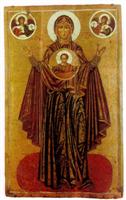
When an Orthodox Christian physician provides medical care to a pregnant woman, the physician finds two patients under his care, mother and child. By the efforts of the physician, may the health of both be improved and preserved.
A physician may encounter a woman who does not want her child or even recognize the fetus as a child. An Orthodox Christian physician must be careful not only to refuse to assist in an abortion, but must also be careful not to merely redirect the mother to another provider who will perform an abortion. If a stranger approaches an Orthodox Christian man and asks, "Will you kill a family member for me?," the Christian should not respond, "Of course, not! - but, I know a hitman who will. He'll do it quickly, effectively, and with as little danger to your other family members as possible." The Orthodox Christian should clearly refuse to commit murder and to aid a potential murderer in carrying out the evil scheme. The time when a scared and confused mother in a chaotic life-situation seeks an abortion may not be a good moment for the physician to abandon a patient by leaving her to an abortionist, although the patient can make a decision to abandon the physician and seek a secular abortionist to carry out her plans. Rather, an Orthodox Christian physician who encounters a woman desiring an abortion can aid a woman's rise out of her own delusion and egotism to realize that she has child (her own child) within her womb and that she is truly a mother, who is called to be a mother after the image of the Theotokos and all the nurturing mother-Saints who have brought forth children.
When caring for young women with unexpected and/or unwanted pregnancies, all who care should do so with great tenderness and love. Information regarding adoption and caring for the child in the context of the family and church can be discussed. Certainly, the physician can call upon a priest to speak with the mother if she is willing. Ultimately, a woman will exercise her will to choose what she will do. The physician, however, should clearly indicate that he is obliged to care for both patients, that abortion is simply the murder of an innocent child (even if the child's conception involved an act of violence), and that, while he will take no part in the murder of a child, he will help the woman in the process of bringing the child into life in the world.
While abortion is often seen as a political issue in our society, for Orthodox Christians it is a matter of expressing love to give life or murdering an innocent victim because of self-love (narcissism/egotism) and delusion. With love and prayer, the physician may be able to preserve the life of a baby and point the mother toward a healthier, spiritually nourishing life.
Selections from early Christian writings, a description of the development of a child in the womb, and other relevant resources can also be found on the Antiochian Archdiocese website.The Orthodox Christian approach to abortion is expressed in a brief submitted to the US Supreme Court (pdf).
The Office of Prayer and Supplication for the Victims of Abortion (pdf) is available on the Antiochian Archdiocese website.
Saturday, December 19, 2009
Christian Bioethics Journal
 Christian Bioethics, published by Oxford University Press, includes articles on bioethics from an Orthodox Christian perspective by Orthodox Christian authors.
"Christian bioethics is a non-ecumenical, interdenominational journal, exploring the content-full commitments of the Christian faiths with regard to the meaning of human life, sexuality, suffering, illness, and death within the context of medicine and health care. Christian bioethics seeks not to gloss over the differences among the Christian faiths, but rather to underscore the content-full moral commitments that separate and give moral substance. It is interdenominational in involving editors and inviting contributions from different Christian perspectives."
Christianity and The Culture Wars
Volume 15, Number 3, December 2009
ARTICLES
"The Infinite without God: Modernity, Christianity, and Bioethics, Or Why Christianity must be Counter-Cultural in the Contemporary World Christian Bioethics" by Aaron E. Hinkley
"The Failed Search for the Neutral in the Secular: Public Bioethics in the Face of the Culture Wars" by Ana S. Iltis
"Moral Pluralism, the Crisis of Secular Bioethics, and the Divisive Character of Christian Bioethics: Taking the Culture Wars Seriously" by H. Tristram Engelhardt, Jr.
"Biopsychosociospiritual Medicine and Other Political Schemes" by Jeffrey P. Bishop
"Religion without God, Social Justice without Christian Charity, and Other Dimensions of the Culture Wars" by Mark J. Cherry
Personal and institutional subscriptions to Christian Bioethics are available. If you would like to subscribe or would like your school's library to subscribe, go to the subscription page or contact us.
Wednesday, December 16, 2009
Orthodox Christian Health Care Providers in a Secular Environment
 “Traditional Christians will be morally disruptive. Contrary to the liberal cosmopolitan ethic, they will indeed seek opportunities for converting others and directing them away from sin, as did the holy unmercenaries of the first centuries. The liberal cosmopolitan is right in discerning a real conflict between the duties of physicians as citizens of a social democracy and physicians as committed traditional Christians. The religious moral integrity of the traditional Christian will be expressed both in stepping back from any involvement in forbidden activities (e.g., abortion, artificial insemination from a donor, physician-assisted suicide) and in providing a witness to the truth of Christianity, which is always an invitation to repentance and conversion” (379).
Source: H. Tristram Engelhardt. The Foundations of Christian Bioethics. Lisse, The Netherlands
Subscribe to:
Posts (Atom)